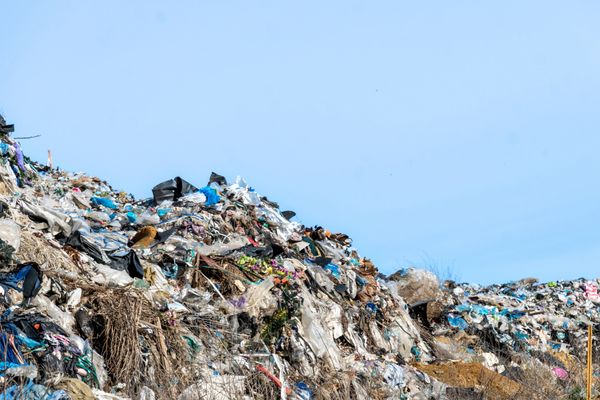
The global waste crisis is not just an environmental burden—it's a lost opportunity. Every day, cities and industries around the world bury or burn millions of tons of waste, releasing harmful emissions and discarding valuable materials. At Ompeco®, we solve this problem by transforming waste into valuable resources. Our technology recovers energy, materials, water and even fuel from what was once considered garbage—without burning, chemicals, or contamination.
By decentralizing waste treatment and enabling on-site conversion into Refuse Derived Fuel (RDF), hydrogen, oxygen, and recyclable byproducts, we eliminate the need for costly transport and polluting incineration. The result is a scalable, clean, circular solution that helps municipalities, hospitals, and industries reduce costs, cut emissions, and reclaim value—turning today's waste into tomorrow's energy. The Converter® reduces waste volume and mass significantly in a 30-minute cycle, with low operating, maintenance, and labor costs. Compared to autoclaves or incinerators, it offers higher ROI and lower CO₂ impact: dry, recyclable end-products, no risk of toxic emissions, and zero wastewater—all contributing to a compelling sustainability ROI.
In a world where resources are rapidly being turned into waste, Ompeco reverses the equation—transforming trash into valuable assets while reducing the volume and weight. Our patented Converter® technology mechanically processes municipal, hospital, and industrial waste into high-quality Refuse Derived Fuel (RDF). In our municipal-scale plants, we go even further—extracting hydrogen, oxygen, and other valuable component materials for reuse or resale. This is more than waste management—it's a breakthrough in waste valorization and resource recovery. Improve health and safety outcomes with rapid ROI.
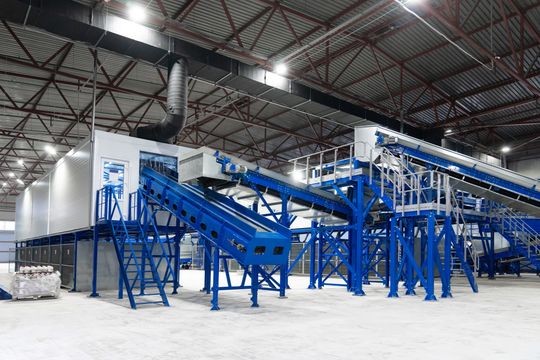
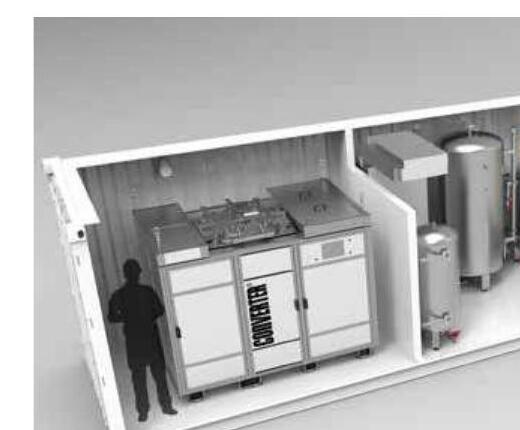
Available in configurations ranging from 400L units for 40–80 kg/h throughput up to 5,000L systems processing 1.5–1.8 t/h, Ompeco's plants provide flexible scalability for municipalities of any size. With footprints from 2300×1500 mm up to 8000×2500 mm, these compact units can be situated near existing waste collection points, reducing logistics and infrastructure costs. Their ISO 9001 and NATO-certified quality underscores their reliability and suitability for both civic and defense clients, ensuring rapid deployment and a lower barrier to entry for partners.
Our patented Converter® process uses friction-generated moist-heat shredding—no chemicals, combustion, pressure, or microwaves—making it safe, low-emission, and scalable. What emerges is fully sterilized, dry, and high-calorific RDF, revolutionizing onsite waste treatment without combustion byproducts or harmful emissions.
| NATO CODE | NCAGE AH649 |
| OMPECO CERTIFICATE | QS 9001 |
| OMPECO CERTIFICATE | QS 14001 |
| International Patent | Converter® technology |
Decentralized waste treatment enabling on-site conversion into RDF, hydrogen, oxygen, and recyclable byproducts.
Friction-generated moist-heat shredding — no chemicals, combustion, pressure, or microwaves.
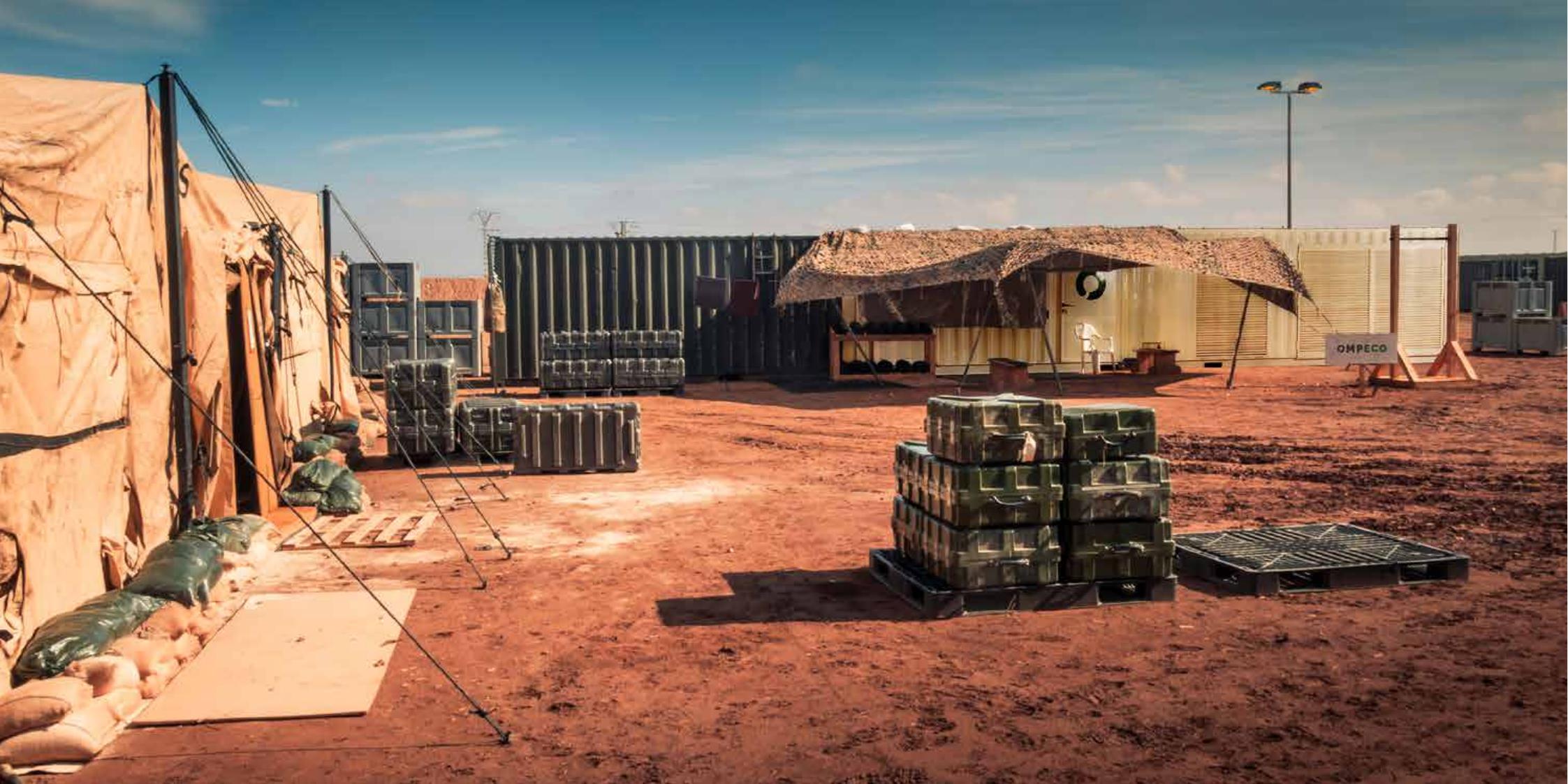
The Converter® MOB is a fully mobile waste treatment unit that brings the proven Ompeco® technology directly to the point of waste generation — eliminating transport, logistics costs, and health hazards. The goal: 0% Waste. Certified ISO 9001, ISO 14001, NATO AH649, and RINA.
The MOB unit transforms unsorted waste into a dry, stable, sterilized product in cycles of less than 30 minutes — with no special operator license required, no pollutant emissions, and zero water consumption.
Waste loaded in plastic bags, lid closed. No pre-sorting required.
Rotor starts and accelerates. Material is finely ground, temperature rises to ~100°C.
Friction heat evaporates moisture. Temperature held at ~100°C.
Once dry, temperature rises to 151°C under moist heat conditions.
Material held at 151°C for 3 minutes via controlled water dosage. Flame-free, no pressure.
Water spray lowers temp to 100°C, vacuum pump reduces adiabatically to 60°C.
Treated material discharged by centrifugal force via servo-operated valve.
3 transfers · ~30 km · ~4 hours · Health hazards, bad smell, transportation costs, pollution
1 transfer · ~3 km · ~15 minutes · Electric vehicles · No pollution · No logistics chain